
Before Insight: The Four Intelligences and the Courage to Not Know
The Passage from Not Knowing to Knowing - Restoring Mathematics to a Human Rhythm

To Not Know
Every genuine insight begins in the same place: a moment of not knowing.
This moment is subtle and often accompanied by fear or difficult emotions and is therefore uncomfortable. The normal human impulse is to side-step or avoid it all together. Yet this very moment is the bridge to true knowing. It is the pause before clarity - the suspension before pattern reveals itself. Historically, however, not knowing came to be treated as failure rather than as a threshold. Confusion was rushed. Silence that required attention was met with impatience. Over time, the body learned to associate uncertainty with danger, exposure, or inadequacy.
Sacred Math begins by restoring dignity to this moment.
To understand why not knowing feels so difficult, we need to recognize that uncertainty has always carried real consequences for human beings.
For most of human history, not knowing was not an abstract inconvenience. It was a matter of survival. To know where the water was, how the seasons moved, which plants healed and which harmed, how animals behaved and how the stars oriented the night sky was to remain alive. Knowledge conferred safety, status and power. Those who knew became guides, elders, shamans and navigators. Those who did not were dependent, exposed and at risk and therefore vulnerable.
This ancient equation still lives in our nervous systems.
Even in modern contexts where survival is no longer immediately at stake, not knowing can trigger a primal sense of exposure. The body responds as if something essential is missing. Without orientation, the organism feels unprotected. This is why uncertainty can evoke anxiety, urgency or a rush to certainty. Even when no real danger is present. This inherited response is ancient and should not be dismissed as irrational.
Knowing, by contrast, creates a sense of control. It stabilizes identity. It tells us where we stand and how to move. In social contexts, knowledge also confers authority. To know is to be less dependent on others, less at risk of judgment, less likely to be overpowered or shamed. This is why many educational systems unconsciously reward speed and certainty rather than depth and honesty. Knowing is equated with competence and not knowing with weakness.
Over time, many people learn to equate worth with certainty.
In this context, not knowing does not merely feel empty. It feels dangerous. It strips away armor. It places the learner in a position of exposure where error is possible, correction is visible, comparison is inevitable and one is seen. The moment before insight is therefore often charged with a subtle threat response. The body tightens. The mind rushes. The impulse is to grasp an answer quickly or withdraw altogether.
Sacred Math does not attempt to eliminate this vulnerability. It works by changing the conditions in which vulnerability is held.
The first thing we need to recognise is that understanding is never produced by the intellect alone. Insight arises when multiple layers of human intelligence come into alignment, and when they are held within a larger field of consciousness that does not belong to the individual alone.
The Four Intelligences
In this work, we speak of four intelligences: somatic, emotional, intuitive and intellectual. These intelligences do not operate in isolation. They unfold within what can be called the spiritual intelligence. Spiritual intelligence refers to the capacity to open into a universal field of consciousness that holds the individual mind, the world and the patterns that govern both. This field has been described across cultures and centuries: as God, Brahman, the One, the divine ground, the living presence or the supramental field. It is not a belief system. It is an experiential reality. It is a spacious, non-fragmented awareness where thought, sensation and meaning harmonise according to an ancient deeper order.
When this field is absent, the intelligences compete. When it is present, they harmonise.
Somatic intelligence
Somatic intelligence is the knowing that arrives before language, before explanation and before certainty. It lives in bodily sensations: a tightening in the chest, a softening in the belly, a sudden surge of energy or a withdrawal. This intelligence does not argue its case. It simply informs. In a culture trained to privilege thought, somatic knowing is often dismissed as vague or unreliable, yet it is the first intelligence to respond to reality. Long before the mind forms a story, the body has already registered what is safe, what is aligned and what is false.
To listen to somatic intelligence requires the courage to pause in not knowing. The body does not speak in neat sentences; it speaks in rhythms, temperatures, pressures, and impulses. When we rush to interpret or justify these signals, we override them. Somatic intelligence asks for patience and humility. It asks for the willingness to stay with sensation without immediately translating it into judgement or action. In this sense, the body becomes a teacher of presence. It trains us to remain with experience as it is, rather than forcing it into the familiar shapes of explanation.
Within the landscape of the four intelligences, somatic intelligence is the ground on which the others stand. Without it, intellectual insight floats unanchored, emotional intelligence loses its compass, and intuitive flashes lack embodiment. When honoured, the body becomes a trustworthy collaborator in insight, guiding us through subtle shifts long before clarity arrives. Somatic intelligence does not eliminate uncertainty; it teaches us how to inhabit not knowing with steadiness, sensitivity, and confidence, allowing understanding to emerge organically.
Emotional intelligence
Emotional intelligence is the capacity to meet feeling without collapse or control. It is not the ability to stay pleasant, nor the skill of managing emotions into socially acceptable forms, but the deeper art of allowing emotion to be fully present without being fused with it. Anger, grief, joy, fear, tenderness - each carries information about relationship, value, and meaning. Emotional intelligence listens for that information without rushing to suppress it or perform it. In doing so, it creates an inner climate where truth can surface without distortion.
To cultivate emotional intelligence requires the courage to remain in not knowing when feeling arises. Emotions often arrive without explanation and the mind is quick to invent narratives to make them tolerable. Yet when emotion is prematurely explained away, its deeper message is lost. Emotional intelligence invites a slower encounter: staying with the raw texture of feeling before naming it, interpreting it or assigning blame. This practice develops discernment. Over time, one learns the difference between emotions that are signals from the present moment and those echoing from older, unresolved patterns.
Among the four intelligences, emotional intelligence forms the relational field in which insight becomes humane. It allows intellectual clarity to remain compassionate, somatic awareness to be metabolised rather than overwhelming and intuitive perception to be grounded in care. Without emotional intelligence, insight risks becoming brittle and disconnected even when it is sharp and insightful. When emotional intelligence is present, feeling becomes a bridge rather than a barrier. It links inner truth with outer relationship and enables us to move through not knowing with openness, rather than closing up in defense.
Intuitive intelligence
Intuitive intelligence is the capacity to perceive coherence before it can be proven. It is a form of knowing that does not proceed step by step, but arrives whole - often suddenly. Intuition recognises patterns, meanings, and directions that have not yet reached conscious articulation. It operates in the liminal space between sensation and thought, drawing on vast, implicit layers of experience. Because it cannot immediately justify itself, intuitive intelligence is frequently mistrusted, yet it is the intelligence that makes genuine insight possible.
Intuition is closely related to imagination, though the two are not the same. Imagination provides the inner imagery, metaphors, and symbolic language through which intuition expresses itself. Where intuition senses, imagination gives form. When imagination is dismissed as fantasy, intuition loses one of its primary vehicles for communication. When imagination is honoured as a mode of perception rather than escape, it becomes a bridge between the invisible and the articulate, allowing intuitive knowing to surface without being forced into premature logic.
To work with intuitive intelligence requires an unusual discipline: the discipline of restraint. Intuition does not thrive under interrogation. It asks for spaciousness, trust, and a willingness to remain in not knowing while something gathers itself. This can feel unsettling, especially in cultures that equate intelligence with speed and explanation. Yet intuition matures precisely through this patience, learning when to speak and when to remain silent until conditions are right.
Within the four intelligences, intuitive intelligence offers orientation rather than instruction. It does not replace thinking or feeling; it quietly aligns them. When honoured alongside somatic and emotional intelligence, intuition helps insight move in the direction of coherence rather than mere cleverness. The relationship between intuition and imagination deserves its own, more spacious exploration, and I will dedicate a separate blog to this later on, where their interplay can be unfolded in greater depth and nuance.
Only then does the intellectual intelligence take its rightful place.
Intellectual intelligence
Intellectual intelligence is the capacity to think with clarity, precision, and restraint. It is not merely the accumulation of knowledge, but the ability to form distinctions, test ideas and recognise when an argument holds or fails. At its best, intellectual intelligence is an instrument of honesty. Its role is to focus and sharpen perception rather than dominating it. It knows the difference between understanding and explanation. Mature thinking can tell the difference between clever language versus when genuine insight has occurred. It knows when it is leaning on fluency to avoid not knowing, and when clarity has actually emerged. This restraint is crucial. Without it, the intellect mistakes articulation for truth. With it, thinking becomes a servant of insight rather than a substitute for it. When grounded, it serves insight by giving structure to what has already been sensed, felt, or intuited.
Yet intellectual intelligence is most trustworthy when it acknowledges its limits. The mind is skilled at constructing coherence where none exists, especially when faced with uncertainty. To practise intellectual intelligence with integrity therefore requires the courage to remain in not knowing - to resist premature conclusions, tidy theories, and borrowed certainty. This restraint protects thinking from becoming defensive. It allows questions to remain alive long enough for deeper understanding to emerge, rather than being closed by the comfort of a quick answer.
Within the ecology of the four intelligences, intellectual intelligence functions as a translator and integrator. It gives language to somatic signals, ethical framing to emotional insight and discernible form to intuitive perception. Intellectual intelligence does not lead the way, but it makes the path walkable. When it functions optimally, it turns experiential insight into shared meaning without stripping it of its depth.
Spiritual Field
Across reputable spiritual traditions, the spiritual field is described as the fundamental ground of being and knowing: the Logos, the ordering intelligence through which existence coheres and unfolds. It is not a personal faculty and not a psychological state, but an ontological field that precedes and contains all innate intelligences. In this view, intelligence is not generated by the individual alone; it is participated in. Human knowing arises because consciousness is already structured by an intelligible order that both holds and exceeds the human mind.
In Neoplatonic philosophy, the One overflows into Nous, the realm of intelligibility, from which all differentiated knowing proceeds. Christian mystics such as Meister Eckhart speak of a divine ground in which the soul knows before it thinks and from which true understanding is born. In Vedānta, this same principle is described as Brahman - the intelligence by which mind, perception, and world are mutually illuminated. Across traditions, the spiritual field is consistently defined as that which knows through us rather than something we possess.
This participatory understanding is articulated with particular clarity in the work of Rudolf Steiner. Steiner describes thinking itself as a mode of perception when it is disciplined and purified - not the production of concepts by the ego, but an encounter with living, objective spiritual realities. For Steiner, human cognition is capable of entering into lawful relationship with the intelligible structure of the cosmos, such that knowing becomes a meeting between consciousness and a pre-existing order of meaning. Intelligence, in this sense, is neither subjective invention nor abstract reasoning alone, but a lived participation in a spiritual field that reveals itself through attentive, ethical, and embodied thinking.
Within modern integral philosophy, figures such as Sri Aurobindo describe this same field as the guiding intelligence of evolution itself. Consciousness is not static but developmental, progressively expressing deeper coherence through matter, life, mind, and beyond. The spiritual field harmonises these movements, ensuring that growth is not merely adaptive or functional, but oriented toward greater unity, truth, and integration. Intelligence, in this sense, is evolutionary participation in an already-present order of meaning.
Seen this way, the spiritual field holds and aligns somatic, emotional, intuitive, and intellectual intelligence. It is the authority by which bodily knowing finds rhythm, emotional life finds ethical orientation, intuition finds direction, and thought finds coherence without domination. The spiritual field does not override human intelligence. It matures it. It restores wholeness and allows understanding to unfold in alignment with a deeper, living order that remains intelligible even when we remain in not knowing.
Insight is Never Final
However, there is one important aspect to keep in mind and that is that insight, once it arrives, is never final.
Every understanding opens onto a new horizon of not knowing. This is not a failure of mastery but the living nature of knowledge itself. Insight deepens in cycles – awakening, alignment, imprinting, deepening, flowering – and then returns again to uncertainty. To learn well is not to eliminate not knowing, but to become increasingly at home within it.
Sacred Math is not about acquiring answers. It is about restoring the inner and universal conditions under which understanding can arise naturally, repeatedly, and with dignity.
Before numbers, there is relationship. Before answers, there is listening and before mastery, there is the courage to be held by what you do not yet know.
An Invitation to Go Deeper
In February, a practice-based space will open for those who wish to explore and develop mathematical–logical thinking through the integration of the Four Intelligences. It will be called How To Think Clearly. The work traces the internal structure of language, its relationship to reality and the way it gradually evolves into mathematical thinking and mathematical language.
The practices unfold gradually and are returned to over time, allowing understanding to deepen rather than rush ahead. Because this work is concerned with clarifying how we think, it asks for sustained, careful engagement. The emphasis is on orientation rather than performance.
Some of this work will be shared openly, offering a clear sense of its direction and intent. Deeper engagement will be held within a reasonably priced paid subscription tier, which will allow the work to be explored thoroughly and with continuity.
Understanding is not something to be pursued. It arrives when the conditions are right.
The Passage from Not Knowing to Knowing: A Physical Example
Lets take the following premise:
The interior angles of any triangle sum to 180 degrees.
Beginning before the answer
Draw an arbitrary triangle on a sheet of paper, with sides of at least 14 cm. No demand is placed on the mind to recall, predict, or perform. The triangle is simply there. Allow the shape to hold your awareness for the next few minutes.
The first response is often familiar: I know this already. I do not need to look more closely. Notice these thoughts and let them pass. Stay with the shape a little longer. Let your eyes move along the edges. Register what you observe and name it inwardly. Three corners. An enclosed figure. A sense of balance or firmness.
You may notice boredom or disinterest. You may feel traces of earlier experiences with mathematics, a teacher, or geometry itself. Or you may feel curiosity and engagement. Shift into an observing stance and notice what happens within you as you continue to look. If tension appears in the body, or if fear or tightening arises, notice that as well. This is important information. Bring awareness to the fact that you are safe. Let the body know that nothing about its survival depends on the outcome of this activity.
Intuition begins to speak
At some point, perception begins to deepen. The triangle is no longer just a familiar shape. It becomes something you do not fully know. Feelings of uncertainty, confusion, or fear may arise, or interest and curiosity may emerge. Do not judge any of this. Allow the feelings to move through the body.
If the experience becomes intense due to earlier difficulty or trauma, pause and take time to regain stability. Do not judge this either. You are crossing a threshold toward understanding and encountering places that may have limited you before.
You may begin to notice the material itself: the paper, the ink, the lines. Perhaps you see three straight movements changing direction in such a way that they meet again. Three corners appear, each shaped by the direction of the turn that formed it. The triangle reveals itself as a relationship rather than an object. Intuitive intelligence begins to sense coherence. It might recognise that the corners belong together, that they depend on one another, and that they form a whole with its own integrity and properties.
The Role of the Spiritual Field in the Process
If you are already aligned with a spiritual field, through your own practice or orientation, it will naturally find its way into this process of growing awareness. When moments of difficulty arise, there is often an instinctive turning toward something larger than the personal will, a higher order of support or a more encompassing intelligence. This turning does not need to be deliberate or conceptual; it happens as a reorientation of the whole being.
When this field is present, the learning process is no longer carried by effort alone. It is held within a wider context of meaning and care. The exploration does not become overwhelming, because it is supported by a sense of being accompanied rather than isolated. Attention softens, fear loses its urgency and understanding is allowed to unfold at a pace the system can sustain.
Whether this is experienced as a guiding presence, a field of intelligence, or a deeper layer of awareness does not matter. What matters is that the process is held within something that does not demand, rush, or judge. In this holding, insight is not forced into being. It is received, stabilised, and integrated as part of a larger movement of coherence.
Making the insight physical
Cut the triangle out completely. At each corner, measure 5 cm along both sides that meet at the angle and mark these points clearly. Draw a straight line connecting the two marks at each corner. This line defines the boundary of the angle piece.
Using scissors, carefully cut out the three angles along these lines. Place the angle pieces next to one another, aligning their vertices along a single straight edge. Together they form a straight line, a 180 degree angle. This is not a mental construction or a remembered rule. It is a physical act of seeing and touching how the relationship holds.
Recognition before explanation
Recognition often arrives before language. The three angles, placed side by side, align into something unmistakably straight. There is a moment of coherence, not a conclusion but a recognition, a felt sense that this could not have been otherwise.
Only after this recognition settles does explanation enter. The intellect is invited to name what has already been seen: a straight line, a half turn, what we call 180 degrees.
What once felt arbitrary now feels inevitable. It does not ask for belief. It carries its own authority.
In this moment, the theorem is no longer an external rule to be memorised. It is a compression of lived understanding. The mind is not persuaded. It is aligned.
From Insight to Proof: The Role of Logic
Once the intellect names that the three angles form 180 degrees and intuition recognises that it could not have been otherwise, mathematics asks one further question: will this always hold, or was this a fortunate accident of this particular triangle?
To answer that, we move from perception into proof. Here we rely on logic - on Logos - the capacity of the mind to reason from shared premises in a way that does not depend on the particular material instance in front of us. (More about this later.)
Given Premises on Which This Proof Rests
Before any reasoning begins, certain shared understandings are already in place. These are not conclusions; they are the ground the proof stands on.
A straight line represents a half-turn. By definition, a half-turn measures 180 degrees.
When two straight lines are parallel, and a third line crosses them, specific angle relationships are created.
In particular, alternate interior angles formed by a transversal crossing parallel lines are equal.
These relationships do not depend on the size, shape or orientation of the figures involved. They arise from the nature of straightness and parallelism itself.
These premises are accepted not because they are asserted, but because they can be established elsewhere through earlier geometric reasoning.
Step-by-Step Proof
Begin with any triangle. Label its three interior angles.
Through one vertex of the triangle, draw a straight line that is parallel to the side opposite that vertex. This new line does not alter the triangle; it simply creates a reference line that shares the same direction as the opposite side.
Each side of the triangle, when extended, acts as a transversal crossing both the base of the triangle and the newly drawn parallel line.
(A transversal is a straight line that crosses two or more other lines at different points.)
Because of this crossing, each interior angle of the triangle is matched by an alternate interior angle on the straight line. By the given geometric rule, these corresponding angles are equal.
As a result, the three interior angles of the triangle can be seen as equivalent to three angles lying next to one another along the straight line.
Since those three angles together lie along a straight line, and a straight line measures 180 degrees, the sum of the three interior angles of the triangle must also be 180 degrees.
This reasoning does not rely on the triangle being a particular kind of triangle. Because the argument depends only on parallel lines and angle equality, it holds for all triangles.
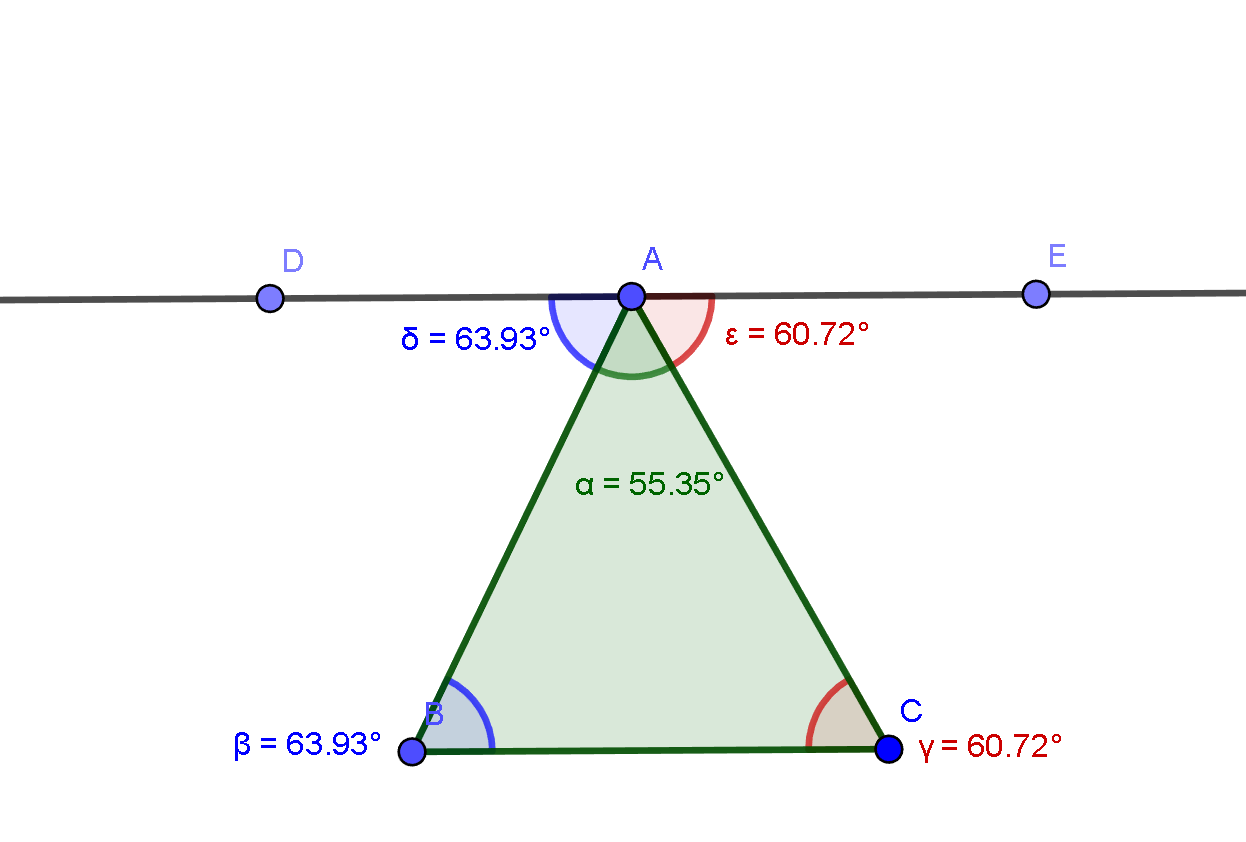
View the interactive diagram here
Triangles - The Bigger Picture
When we say “the angles of a triangle add to 180 degrees,” it sounds like a rule about a shape drawn on paper. But that is almost a misdirection. What is really being named is a relationship between straightness, turning and the space in which the turning happens. A triangle is not primarily a thing. It is an event. You walk straight, you turn, you walk straight again, you turn again, and after the third turn you return to where you began. The total amount of turning required for that return is fixed. In flat space, it is exactly 180 degrees. This is the domain of Euclidean geometry, the geometry that describes flat space where straight lines behave predictably and parallel lines do not meet, first systematised by Euclid.
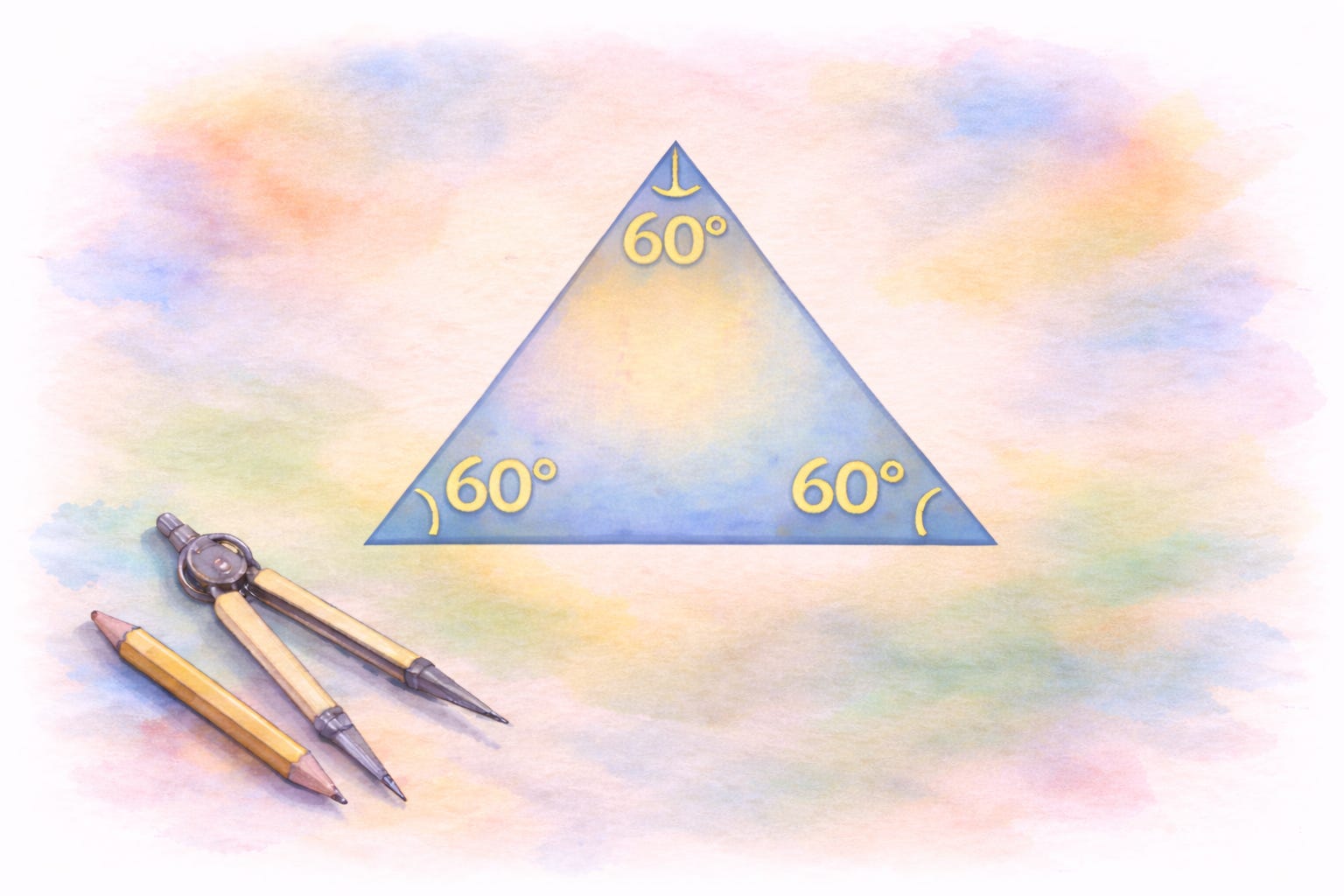
Because the Earth is very large, its curvature is negligible at everyday scales. For small triangles drawn or measured on its surface, space behaves as if it were flat, which is why Euclidean geometry applies so successfully and the angle sum appears to be 180 degrees with very high accuracy. Only when triangles become large enough for the Earth’s curvature to matter does the underlying bending of space reveal itself. On a sphere, such as the Earth taken as a whole, you can walk three straight paths, turn three times, and return to your starting point having turned more than 180 degrees in total. Nothing has gone wrong with the triangle; space itself has demanded more turning. On a saddle shaped surface, the opposite happens: space offers less resistance, the turning required shrinks, and the angle sum falls below 180 degrees. In every case, the triangle faithfully records the character of the space it inhabits.
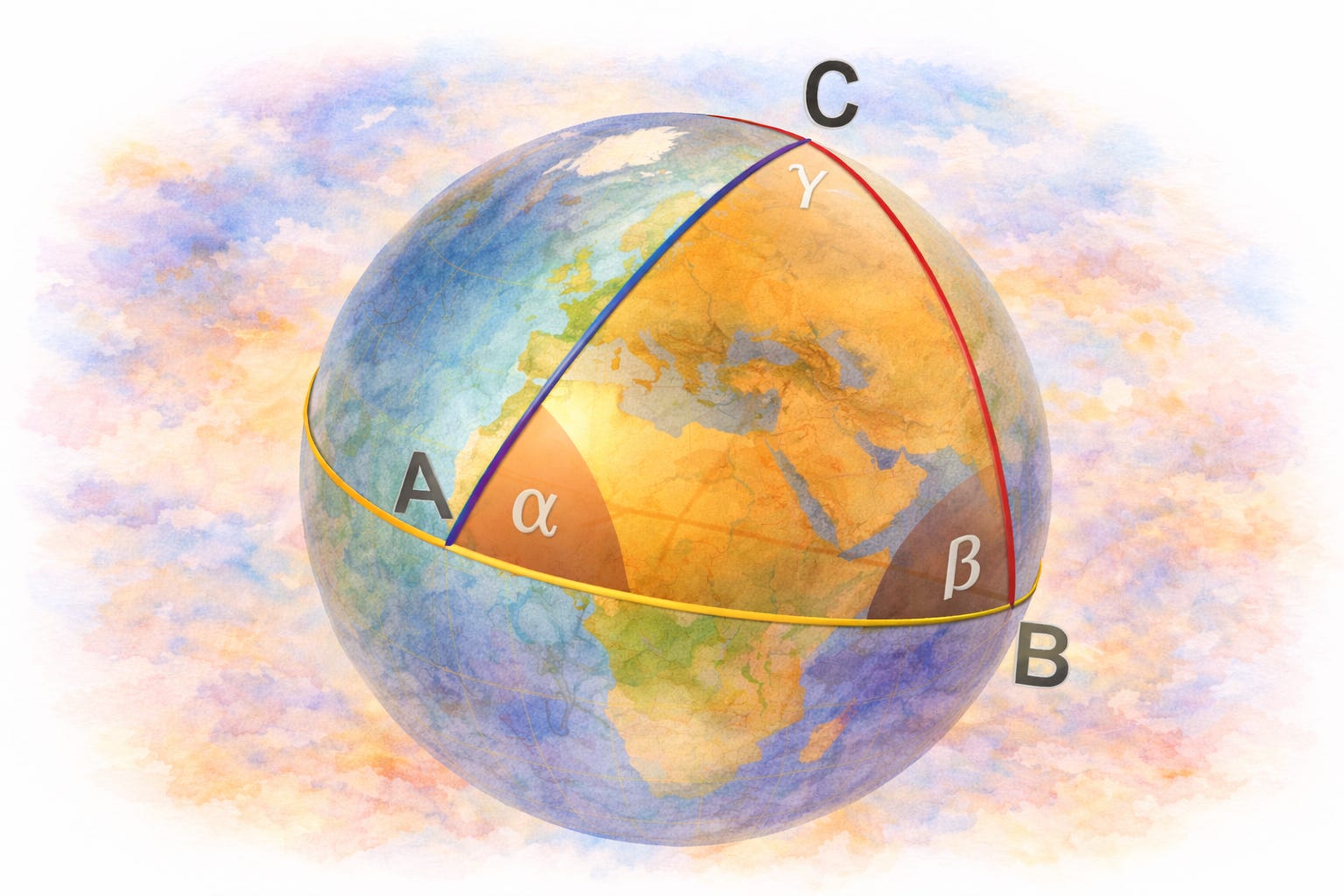
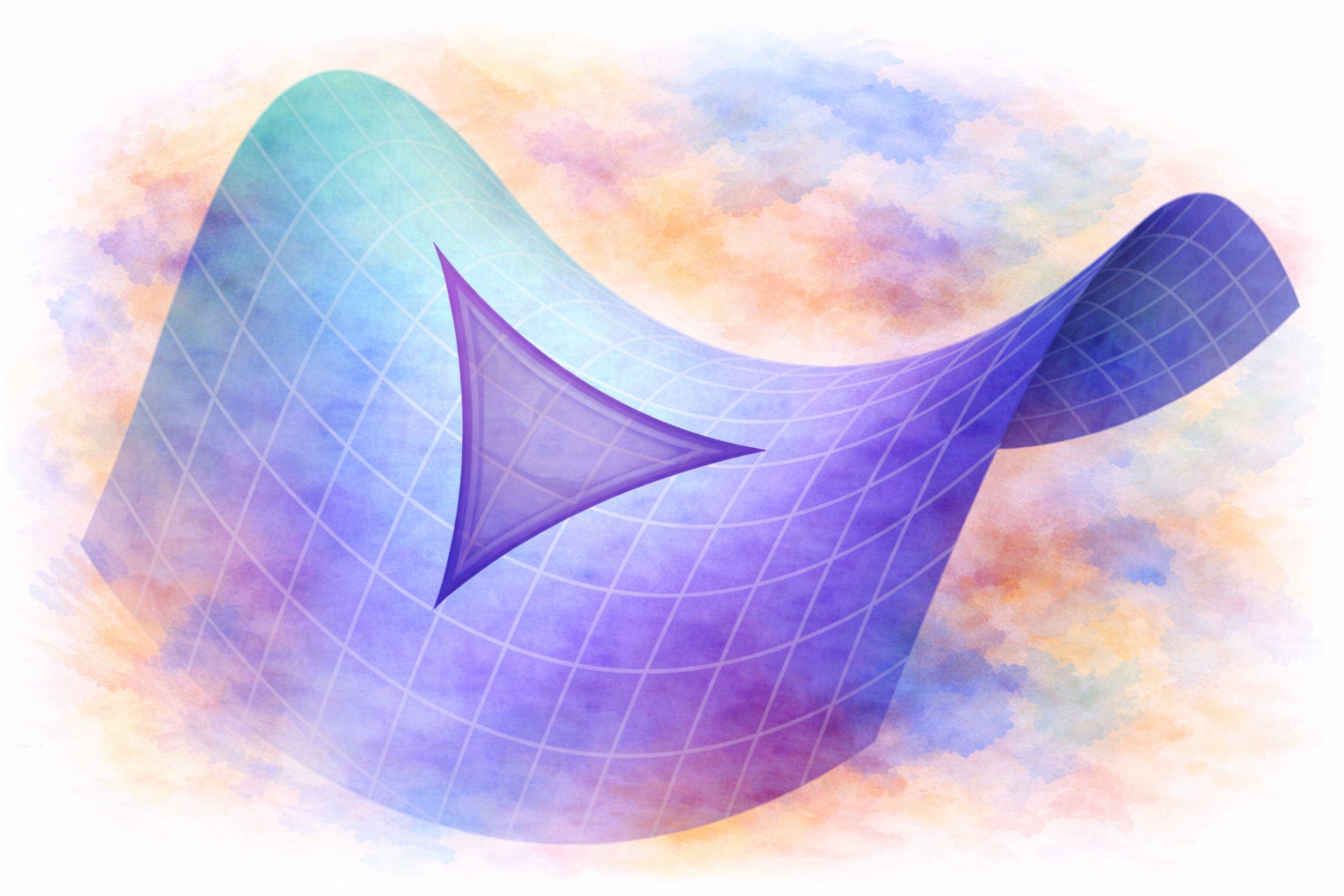
Seen this way, the theorem is not about geometry as a human invention. It is about orientation. It is about how direction behaves when you try to remain faithful to straightness. The triangle becomes a measuring instrument for reality itself. Without knowing it, the student who first meets this theorem is already touching a profound idea: that space is not an empty container but an active participant in form.
Philosophically, this matters because it dissolves the idea that mathematics is a set of rules imposed from above. The triangle does not obey the 180 degree sum because we decree it so. It does so because of a deeper agreement between straightness and flatness. Where that agreement changes, the mathematics changes. The world leads. Mathematics listens.
There is also something existential hiding here. The triangle is the simplest closed act of return. You leave, you turn, you leave again, you turn again, and eventually you come home. The fact that this return has a precise measure in flat space tells us that our world is locally coherent. It does not fold unpredictably under our feet. It allows orientation, memory, and navigation. That reliability is not abstract. It is what makes building, walking, drawing, and even thinking possible.
So when a person encounters the 180 degree sum, they are not just learning a fact. They are encountering the trustworthiness of the space they live in. They are seeing that the world has an inner order that can be met, tested, and known. Mathematics, at its best, is the language of that meeting.
Restoring Mathematics to a Human Rhythm
What matters here is not the geometry itself, but the sequence through which understanding was allowed to unfold - and the field that made that sequence possible. Not knowing was not something to be eliminated quickly. It was held. That holding allowed attention to gather, perception to sharpen, and insight to emerge organically.
The body remained present and was allowed to experience the truth.
Emotion was held safely, without judgement.
Intuition was allowed, honoured and trusted to lead with further investigation.
The Intellect arrived last, to clarify and confirm.
The Spiritual field held the process, regulated it into something safe and doable, and harmonised the different forces at work.
We have placed the theorem within a larger philosophical context by revealing it not as a formal rule about triangles, but as an encounter with the coherence and trustworthiness of space itself.
This is what it means to restore mathematics to a human rhythm.
When understanding arises this way, confidence does not need to be manufactured. It emerges naturally from coherence. The student does not think, “I was told this is true.” They recognise, “I have seen why this holds.”
The same inner choreography applies far beyond geometry. Algebraic relationships, proportional reasoning, even formal proofs rely on the same order of arrival. When that order is held within a stable spiritual field, mathematics no longer feels like an external authority demanding obedience. It becomes a language that names relationships the mind has already learned to perceive.
This is why Sacred Math insists on beginning before numbers. Meaning must arrive before structure can hold it. The spiritual field provides the inner space in which meaning can form. When abstraction is grounded in lived understanding, rigor no longer intimidates. It supports.
And slowly, often to one’s own surprise, the old relationship begins to shift. Not knowing loses its charge. Curiosity returns. Mathematics becomes less a test of worth and more a way of listening - to pattern, to relation, and to the field of intelligence that has been present all along.
A Note on Method and Context
Sacred Math stands in dialogue with a wide range of contemporary educational, philosophical, and contemplative traditions. Current pedagogy increasingly recognises that learning is not a purely cognitive activity, but a whole-human process involving embodied experience, emotional meaning, perceptual attunement, intuition, and conceptual articulation. Research in embodied cognition (as articulated by thinkers such as Francisco Varela, Evan Thompson, and Eleanor Rosch), constructivist learning theory (from Jean Piaget to Lev Vygotsky), and multiple intelligences (Howard Gardner) has all contributed to this shift, alongside developments in holistic and contemplative education that emphasise presence, meaning, and integration rather than performance alone. Waldorf Education, founded by Rudolf Steiner, has long embodied this orientation in practice, foregrounding the role of bodily engagement, imagination, rhythm, emotional life, and spiritual development as integral to genuine understanding rather than peripheral to it.
Philosophical and spiritual traditions likewise offer highly refined and sophisticated models of the human being. Non-dual Vedānta, Neoplatonism, Christian mysticism, Sufi metaphysics and modern integral philosophies such as that of Sri Aurobindo all articulate layered architectures of consciousness and knowing with great subtlety and depth. Sacred Math honours the validity, richness, and insight of these traditions and recognises their enduring contribution to our understanding of human cognition and consciousness.
At the same time, Sacred Math makes a deliberate methodological choice. For the purposes of experiential understanding, pedagogical clarity and practical integration, human knowing is articulated here through four intelligences - somatic, emotional, intuitive, and intellectual - held within a unifying spiritual field of awareness. This fourfold structure is not intended as an exhaustive account of human consciousness, but as a functional synthesis: one that preserves essential distinctions while remaining simple enough to be experienced directly and worked with in real time.
In practice, this level of distillation proves not reductive, but enabling. It avoids conceptual overload, supports embodied engagement, and allows learners to recognise and restore coherence when understanding falters. By prioritising experiential accessibility alongside philosophical integrity, Sacred Math seeks to offer a framework that is both rigorous and usable - one that serves understanding rather than eclipsing it.
I loved this; thank you!