
How the Body, Language and Experience Create the Foundations of Mathematical Thinking
How the language of relationships, boundaries and distinctions prepares the mind for number

This piece explores how somatic experience, emotional resonance, intuitive perception, and linguistic structure form the quiet scaffolding beneath mathematical understanding. Mathematics grows through the whole human being - and recognising this path changes how we teach, learn and meet the subject inwardly.
The Body as the First Mathematician
Mathematical thinking begins long before numbers appear. Its first roots grow in the body. Long before a child can speak or recognise symbols, their movements, sensations, balance, rhythm and gestures are already organising experience in a mathematical way. Every reach, fall, climb and imitation traces the first patterns of order. The body measures long before the mind knows it is measuring and through these small actions the organism prepares the ground on which later understanding will stand.
Language enters later and reshapes these early physical patterns into forms the mind can revisit. In this sense, mathematical thought grows through stages. The body prepares the structure and language strengthens it by giving shape to distinctions already lived inwardly. Through words, experiences become clearer. They can be compared, grouped and related. Over time these relations stabilise, and once they hold steady in thought they can be represented through numbers and symbols. Mathematics crystallises relationships that were first felt physically, then sensed emotionally and intuitively, and finally named by the intellect.
At its most immediate level, language helps us notice difference. Naming something draws a boundary around it and gives it a place within awareness. This act of distinction begins somatically. An infant senses warm and cold, near and far, steadiness and imbalance. When language arrives, these sensations brighten and sharpen. Without distinction, comparison becomes impossible, and without comparison, relations have no structure. Each time a child distinguishes “this” from “that,” a bodily sense becomes a conceptual one. These small acts of noticing are early rehearsals for mathematical clarity.
Boundaries arise first in movement and sensation. Later, language brings these boundaries into thought. It lifts an experience into a form the mind can return to, hold and shape. Language works as an instrument of consciousness, describing patterns that first entered through the senses and allowing these patterns to be carried inward.
As soon as experiences begin to find expression in words, something fundamental shifts. Everyday words such as “same,” “different,” “inside,” “outside,” “near” and “far” may appear simple, yet they shape perception powerfully. They give structure to space, identity and relationship. They guide the child’s attention toward patterns already present in their movements and sensations. This echoes what Rudolf Steiner indicated: the intellect grows out of the body’s formative activity. Sensation develops into perception, and perception becomes concept. When a child understands “same” and “different,” the first seed of equivalence is present. When they grasp “between,” spatial reasoning begins to unfold. These meanings arise inwardly before they are spoken. They are felt first, then recognised and only later named. Language steadies what the body has already begun.
Words do more than reflect experience. They direct attention. Once a word exists, the mind begins to seek its meaning in the world. It begins to look for sameness, notice repetition and sense proportion. Through repeated use, language strengthens the habits of perception that support pattern recognition. Somatic intelligence offers the first orientation, emotional and intuitive forms of intelligence refine it, and linguistic intelligence gives it clarity.
Counting relies on these earlier developments. Before numerals mean anything, words such as “first,” “next,” “last,” “more” and “less” establish order, direction and magnitude. They introduce sequence into lived experience, a sequence the body has already enacted by stepping, climbing, waiting and repeating. A child arranges events in time long before they count. An adult structures a day in much the same way. The same architecture is present: the sense that one thing follows another in a pattern that can be revisited. Three only starts to make sense once a child already feels the order of things in their body and can match that feeling with the words they know.
Grouping grows from the same soil. Words such as “all,” “some,” “none” and “many” gather elements into mental collections. The body rehearses this by holding several objects, tidying toys or filling a basket. Emotionally and intuitively, the child senses a kind of “togetherness.” Language lifts this sense into conceptual form, allowing the mind to treat multiplicity as a unit. This is the origin of set thinking.
Relation words play a similar role. “With,” “without,” “and” “or,” “if” and “then” all direct attention toward connection. These are early forms of logical structure. They teach that meaning lives in relationships as much as in individual things. This capacity begins as an intuitive sense that one thing belongs with another or follows from another. Later it becomes deliberate reasoning.
Negation supports this development as well. Words such as “not,” “no” and “never” introduce absence as something that can be thought and held in mind. At first this is a bodily experience - something was present and now is gone. Emotional understanding interprets this absence. Intuitive understanding forms expectations around it. Eventually the intellect names it. Negation supports the ability to handle limitation, boundary and conditional thought - all essential for mathematics.
Over time, these linguistic structures settle. They gain stability through daily use. The mind learns to hold distinctions without losing them, to recognise relationships without blurring them, and to compare experiences without confusion. Mathematical clarity rests on this stability.
From this perspective, mathematics does not arrive suddenly. It grows gradually, through the body, the emotions, intuitive patterning and the shaping power of language. Numbers and symbols refine these abilities. They do not create them.
To understand mathematics deeply is to see this arc of development. Each time we use language precisely - whether speaking with a child or refining our own thinking - we rehearse the same underlying movement. We distinguish, compare, relate and draw boundaries. Inside every word lives a small memory of early physical experience: the wobble of balance, the effort of standing, the reach toward the world. Those gestures created the early conditions for abstract thought.
From One to Many: How Language Prepares the Mind for Number
The Emerging Sense of Quantity
Before numbers appear as symbols, the body and senses already register quantity. Infants notice the difference between one object and two without thinking about it. This is the body responding to amount directly. As children grow, emotional and intuitive awareness strengthens this early sensitivity. One caregiver leaving matters. One missing toy matters. A collection of toys brings excitement, while too many sensations at once can feel overwhelming.
The word “one” later gathers these experiences into a single, coherent idea. What first appears in the body becomes something the mind can hold as a concept.
The Meaning of One and the Nature of a Unit
Unity as a Singular Reality
In Rudolf Steiner’s view, unity is more than simply the numeral “1.” It refers to something that exists as a complete whole, something that cannot be divided without becoming something else entirely. Some realities can only be understood this way. There is one Earth, one Moon, one Sun in our sky and one self through which each person meets the world. These are not examples of “one” in the sense of counting items in a line. They are examples of genuine unity - single beings whose identity depends on their wholeness. Half an Earth or two versions of you would no longer be the same being.
When children encounter these singular realities, they meet the deeper meaning of a unit. A unit is something that stands as a whole in its own right. This lived sense of unity enriches the idea of “one,” because it shows that some things are singular by their nature. That recognition becomes an essential foundation for later number concepts, where the stability of the unit is the starting point for understanding parts, multiples and relationships of quantity.
Unity as a Single Object
A unit can also be understood as one complete object - such as one apple. This kind of unity is simpler than cosmic unity, but it still depends on the idea of a whole. One apple is one intact thing.
When a single whole object is divided - such as one apple cut into four pieces - the original unity disappears. The apple is no longer one complete thing. It becomes parts of what used to be a whole. This forms the basis for understanding fractions of a single object.
The Emergence of Multiplicity
Multiplicity grows out of this early unity. “Many” points to a spread of things without fixing an exact amount. Children recognise this spread long before they count. Adults rely on the same structure when speaking of many tasks or many concerns. Emotional and intuitive faculties give this spread its inner shape. Language then strengthens that shape.
The movement between “one” and “many” begins as physical experience. One body climbs many steps and discovers sequence. One hand gathers several stones and discovers collection. Through these everyday actions, children develop an early sense of quantity: one thing is a single item and many things form a group.
Collections and Their Division
A collection behaves differently from a single object.
If you have a group of eight apples and divide the group into halves or quarters, the unity of the items in the group stays intact. You still have the same eight apples; you are simply organising them into smaller sets. This supports concepts such as equal groups, set fractions, ratios and comparisons within collections.
These abilities develop long before formal counting. Early experiences with single objects and groups of objects create the structure that later allows children to understand fractions, ratios, sets and the relationships between parts and wholes.
More, Less, and Enough: How Comparison Gives Rise to Quantity
Quantity is sensed before it is counted. The body continuously compares: heavier and lighter, nearer and further, faster and slower. Emotional intelligence interprets these differences as comfort, discomfort or interest. Intuitive intelligence recognises patterns such as higher and lower, sooner and later. Language gives these patterns clarity.
Words such as “more,” “less,” “same,” and “enough” refine this inner sensing and introduce conceptual quantity. “More” and “less” express relational structure. “Same” offers invariance. “Enough” introduces sufficiency. These ideas begin in the body, take form in emotion and intuition, and settle when the intellect names them.
Comparison also introduces direction. “More” and “less” imply an order, the early shape of the number line. Somatic experience provides this long before numbers appear—climbing higher, stepping further or waiting longer. Adults rely on the same patterns when adjusting recipes, managing time or balancing money.
Language deepens context. More relative to what? Less compared to what? Enough measured by which standard? These questions strengthen reasoning and reveal how mathematical thinking grows stage by stage, rooted in lived experience.
Mathematical thought unfolds from movement, rhythm, spatial orientation, balance and sensory discrimination. Emotional attunement and intuitive patterning deepen it. Language transforms these experiences into concepts that can be held and refined. To think mathematically is to recognise this whole journey, a journey that remains alive in every human being.
Expert Insights: What Leading Thinkers Say About Language and Mathematical Thought
Modern thinkers across mathematics, cognitive science and philosophy offer insights that support this view. Keith Devlin describes mathematics as the study of patterns and relationships, showing how humans recognise these patterns through language long before encountering numbers. George Lakoff and Rafael Núñez demonstrate that mathematical concepts arise from embodied experience and the conceptual structures embedded in language. Brian Butterworth finds that humans possess an instinctive sense of quantity, yet mathematical understanding becomes conceptual only when language stabilises these perceptions. Bertrand Russell highlighted the logical structures within language that support mathematical reasoning. Henri Poincaré emphasised that mathematics begins in recognising relational structure across different experiences.
These perspectives converge on a simple truth: mathematical understanding grows from the ways language shapes experience, relation and meaning.
Mathematics lives much closer to the human being than we often realise. It does not wait in textbooks or appear only when children learn to count. It grows through touch, balance, movement, emotion, intuition and the shaping force of language. When we speak with care, invite attention to relationships and honour the intelligence carried in early experience, we strengthen the roots from which true mathematical understanding unfolds.
Here are ten easy ways an adult can strengthen their mathematical sense of the foundational words - same, different, inside, outside, near, far, more, less, enough, between, part and whole.
Strengthening these early mathematical perceptions begins with something very simple: noticing. When you name a relationship in your mind - this is inside, that is further, these two are the same, this feels like enough - you’re giving a moment of shape to your experience. There’s no need to hold onto it or analyse it. You just notice, acknowledge it within yourself, and let it pass. This gentle cycle creates clarity without pressure. Over time, the mind becomes more attuned to structure, not through effort, but through steady, relaxed awareness.
When arranging or tidying a space, pause briefly to notice relationships. As you place objects on a shelf or in a drawer, name the spatial structure in your mind: this goes inside, this sits beside, this belongs behind. These small recognitions strengthen your internal map.
When cooking, pay attention to comparisons. Notice when one ingredient feels like too much or too little, when two bowls contain roughly the same amount, or when you have just enough of something. These everyday judgements mirror the roots of quantitative reasoning.
On walks, observe distance and position. Notice what is nearer, what is farther, what sits between landmarks. You’re refining the spatial vocabulary your mind uses to organise the world.
When folding laundry or packing a bag, attend to containment and fitting. You are working with ideas of inside, outside, part, whole, and capacity — all fundamental mathematical relationships.
While organising tasks or planning your day, observe sequence words. First, next, after, before. These build the mental timeline that underlies counting, ordering, and logical structure.
Compare shapes and sizes in the environment. Two trees might be different heights yet the same in width. Two books may differ in colour but share a similar form. These recognitions train equivalence without collapsing difference.
Notice patterns in sound, movement, or behaviour. Rhythm in footsteps, repetition in daily routines, symmetry in architecture — each is a form of mathematical relation already present in experience.
When reading or watching something, pause to notice relational words: and, or, if, then, without, with. These shape the logical structure of thought. Becoming aware of them strengthens your ability to follow complex reasoning.
During conversation, listen for negation. Words like not, never, none and nothing create boundaries in meaning. Attending to them helps you perceive how conceptual limits are formed.
In moments of choice, observe grouping. When choosing groceries, clothes, or tools, notice when your mind gathers items into sets - all the fruit, all the winter clothes, all the stationery. You are engaging the same mental actions used in early set theory.
Here is a story along with several playful activities for children (aged 5 –8). They help build the first foundations of number sense through movement, noticing and language.
One Apple and Many Apples
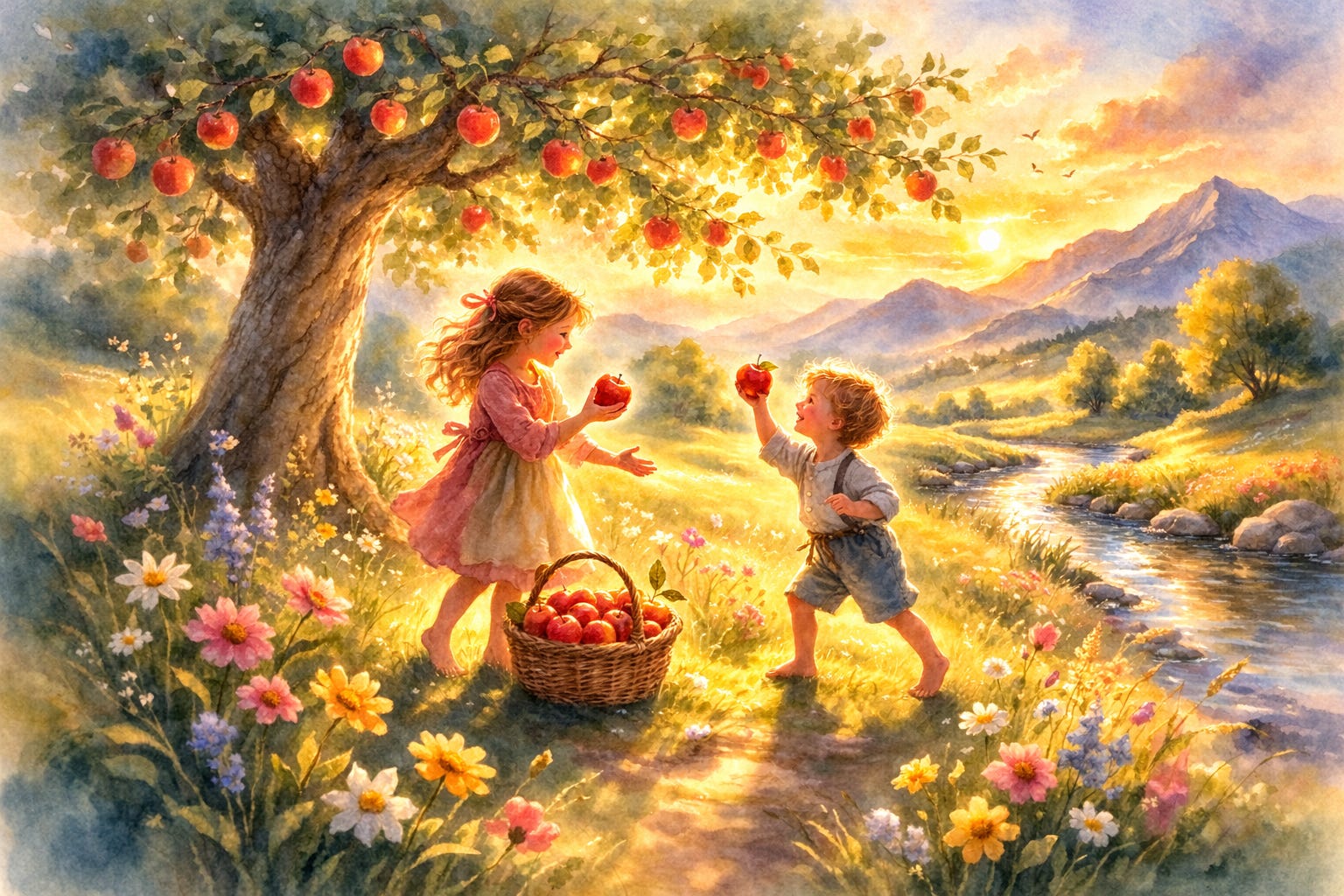
Mila found one red apple under the tree.
It was round and shiny and small enough to fit in her hand.
“One apple,” she said softly, holding it up to the light.
Then she looked around.
There were many apples in the grass. Some were big. Some were small. Some were hiding under leaves.
Mila picked up one more.
Now she had two.
She picked up many more and placed them in her basket.
Her basket began to feel heavy.
“Do I have enough?” she wondered.
She looked at her little brother. He was watching with wide eyes.
She gave him one apple.
Now he had one.
She had many.
He laughed and held his apple high. “Mine is the same as yours!” he said.
They compared them carefully.
His apple was smaller.
Hers was bigger.
“Not the same size,” Mila smiled, “but both are one apple.”
They placed all the apples back into the basket.
The basket was now one whole basket of apples.
Many apples.
One basket.
They carried it together to the house.
On the way, they saw birds in the sky.
One bird flew past.
Then many birds swooped together.
“More birds!” her brother shouted.
The birds landed in the tree.
Now there were fewer in the sky and more in the branches.
Mila stopped and looked carefully.
“One tree,” she said.
“Many branches.”
“Many birds.”
“One sky holding them all.”
Her brother thought about this.
“The sky is very big,” he said. “It has enough space for everyone.”
Mila nodded.
They walked home slowly, their bare feet pressing into the warm earth, feeling the ground steady beneath them. They carried one basket filled with many apples under one wide sky.
The earth held their steps.
The basket held the apples.
The sky held the birds and the light.
And everything belonged together.
Here are twenty playful ways to grow those early perceptions.
Shell or Stone Hunts
Go outside and collect “one special stone,” then “many small stones.” Later, gather them into “one pile.” Let the child rearrange the same objects as one collection and as many pieces.Snack Sharing Ritual
Place a small bowl of grapes or nuts on the table. Ask, “Do we have enough for everyone?” Let them distribute. “Who has more? Who has less? Is it the same?”Footstep Measuring
Walk across a room counting steps. Then try giant steps. Which takes more? The body becomes a measuring instrument.Water Play Comparisons
In the bath or with buckets outside, pour water between containers. Which holds more? Which is full? When is it enough?Sound Clapping Games
Clap once. Clap many times. Clap the same rhythm twice. Ask them to listen for sameness and difference.Building Towers
Build two block towers. Which is taller? Add one block. What changed? Remove one. What remains?Nature Sorting
Collect leaves and sort them by size. More big leaves or more small ones? Can they make one group from many scattered leaves?Treasure Tray
Place a mix of objects on a tray. Ask for “one smooth thing,” “many tiny things,” or “all the round things.” It trains grouping and unity.Cooking Together
Let them pour one cup of flour. Add more. Ask if it looks the same as before. Enough sugar? Too much?Line-Up Games
Have children line up by height. Who is taller? Who is the same? Rearrange and notice that order changes but the group remains one class.Shadow Watching
Observe shadows in the late afternoon. Which shadow is longer? Does more sunlight make a shorter shadow?Toy Rescue Story
Tell a story where “one teddy is lost among many animals.” Let them physically find and regroup the characters.Rhythm and Pause
Drum softly, then louder. More sound, less sound. Let them feel intensity as quantity.Folding Paper
Fold a paper in half. Now it has two parts. Fold again. Many parts from one sheet. Unfold and notice it remains one whole.Garden Counting
Plant seeds. Notice one sprout, then many. Watch growth over days. Quantity becomes something alive.Balance Scale Play
Use a simple homemade balance with a hanger and cups. Which side goes down? Add one pebble. What happens?Story Questions
While reading, ask: Are there more birds in the sky or on the tree? Is there enough food for all the characters?Sorting Laundry
Match socks. One pair. Many pairs. Are they the same size? Larger and smaller become visible realities.Drawing Multiplicity
Ask them to draw one sun, then many stars around it. Later, circle them as one sky.The “Enough” Game
While tidying up, ask, “Do we have enough toys in the box?” Let them decide. It teaches sufficiency rather than excess.